What Is Halal Meat in Islam? A Clear Guide to Halal Standards and Practices
Halal meat is a concept that sits at the intersection of faith, food, animal welfare, and everyday life. For many Muslims and for many people who plan meals with dietary restrictions in mind, understanding what makes meat halal goes beyond a simple label. It involves a set of standards that cover the life of the animal, the method of slaughter, the handling of the product after slaughter, and the absence of prohibited ingredients. This guide aims to illuminate the core ideas, the practical steps, and the ethical dimensions behind halal meat in Islam, using terms such as zabiha, dhabiha, and bismillah to describe the tradition with accuracy and sensitivity.
Throughout this article you will encounter several variations used to refer to the same general idea. Terms like halaal, halāl, and halal-slaughtered meat are common in different communities and countries. You will also see references to zabiha or dhabiha as transliterations of the method of slaughter that is central to traditional Islamic law. By exploring these variations, the article provides semantic breadth while keeping the substance intact.
Defining Halal Meat: What Makes Meat Halal in Islam?
In its most essential form, halal meat is meat that has been prepared in accordance with Islamic law (sharia) and is considered lawful for Muslims to eat. The definition rests on a few core concepts:
Permissibility: The animal and the act of slaughter must be permissible according to Islamic teachings. Animals that are explicitly prohibited (haram), such as pigs, are not allowed for halal consumption.
Cleanliness and purity: The meat should come from a healthy animal and should be processed in a clean, hygienic environment to avoid contamination with haram substances.
Proper slaughter: The animal must be slaughtered in a specific way that minimizes suffering, and the invocation of God is ordinarily required.
Intent and blessing: The person performing the slaughter typically recites a formula invoking God’s name and seeks to fulfil the intention of serving neydah (a spiritual intention) while carrying out the act, often summarized as niyyah (intention).
The idea of halal is not merely about the absence of forbidden things; it is also about ensuring that the meat comes from animals that have been treated with care and respect, that are slaughtered for the purpose of lawful consumption, and that every step of the process aligns with ethical and religious standards.
The Slaughter Method: The Core of Dhabiha or Zabiha
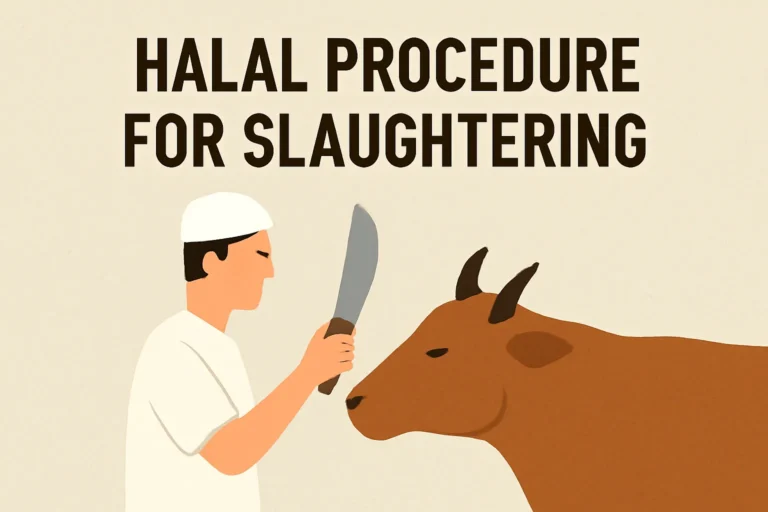
The term dhabiha (also spelled zabiha) refers to the Islamic method of slaughter that renders the meat permissible. This method has several critical components, and understanding them helps explain why halal slaughter is distinct from other forms of slaughter.
Key requirements for the slaughter
Pronouncement of God’s name: At the moment of slaughter, the name of God should be invoked, commonly with the phrase “Bismillah, Allahu Akbar”, which means “In the name of God, God is the Greatest.” Some communities simply say “Bismillah”.
Single swift cut: A swift, uninterrupted cut to the throat that severs the major blood vessels (the trachea, esophagus, and the main blood vessels) is preferred. The goal is to ensure a quick and humane death with minimal distress to the animal.
Healthy animal: The animal must be healthy and capable of carrying out the act. Animals that are ill, injured beyond recovery, or in distress should not be slaughtered for halal meat.
Consciousness and flow of blood: The animal should be alive at the moment of slaughter, and the method should facilitate proper drainage of blood, producing a product that is clean for consumption.
Stunning: Some halal authorities permit certain forms of stunning (electrical, gas, or reversible stunning) provided the animal does not die as a result of the stunning and the slaughter is still performed in the prescribed way. Others require no prior stunning and insist on immediate slaughter. The stance varies by country, by certification body, and by school of thought within Islam.
Species-specific rules: While the general principle allows cattle, sheep, goats, camels, and poultry, different communities may apply additional guidelines for each species to ensure humane handling and proper slaughter.
The practice of zabiha or dhabiha is not simply a ritual; it is a process that emphasizes humane treatment, attention to the animal’s welfare, and a clear acknowledgment of the divine name during slaughter. Muslims who uphold this tradition often regard it as a spiritual duty as well as a practical method for ensuring food compliance.
Animals and Ingredients: What Is Allowed and What Is Prohibited
The scope of what is halal meat is closely tied to the types of animals that are permissible and to the status of other ingredients in processed foods.
Permissible animals for halal meat
Land animals commonly included are cows, sheep, goats, camels, and fowl such as chickens, turkeys, ducks, and quail, provided they are slaughtered according to the dhabiha method and free from prohibited additives.
Fish and many seafoods are generally considered halal by the majority of scholars, though there are some differing opinions in certain communities about specific species or regional practices.
Prohibited animals and products
Pork and pork products are universally forbidden in Islam.
Carrion (dead animals not slaughtered according to dhabiha) is not halal.
Carnivorous animals and birds of prey are typically not halal.
Beyond the animal itself, halal standards also apply to ingredients inside processed foods. Even if the meat comes from a halal animal, the product may become non-halal if it contains haram (forbidden) additives such as alcohol, certain animal fats, or flavorings derived from non-halal sources. This is why many Muslims prefer products with reliable halal certification on the package.
Cross-contamination and processing
A practical concern for households and restaurants is cross-contamination—the accidental transfer of haram substances to halal food. It is common for halal-conscious consumers to seek dedicated utensils, separate preparation areas, and careful labeling to ensure that halal meat remains free from contamination by non-halal ingredients or equipment.
From Farm to Table: The Halal Processing Chain
The journey of meat from farm to table involves multiple stages, each with potential points where halal status could be compromised. A typical halal processing chain includes farm management, transport, slaughter, dressing, processing, packaging, storage, and distribution. Each stage offers opportunities to maintain or jeopardize compliance with halal standards.
Farm practices and animal welfare
Animals should be raised in humane conditions, provided with adequate food and water, and kept free from unnecessary stress.
Care should be taken to prevent injury and illness that would compromise the animal’s welfare or the meat’s quality.
Slaughterhouse requirements
Only authorized personnel should perform the slaughter, and they should be trained in the dhabiha method.
Facilities should be clean, with processes designed to minimize suffering and to ensure proper drainage of blood.
During processing, halal-certified facilities must ensure ingredients are halal and equipment is not cross-contaminated with haram materials.
Packaging should clearly indicate halal status and the name of the certification body where applicable.
In practice, many Muslims rely on halal certification to navigate the complex world of processed foods. Certification bodies inspect facilities, verify ingredient lists, and monitor adherence to standards. The resulting halal logos and certificates provide consumers with confidence that the product meets the necessary criteria.
Certification, Oversight, and How to Verify Halal Status
Given the global market for meat and meat products, halal certification acts as a bridge between religious requirements and modern manufacturing. Certification bodies vary by region, but most share common principles: clear standards, periodic audits, and transparent labeling.
What is halal certification?
A formal acknowledgment that a product or establishment adheres to halal standards.
A certification body typically assesses sources of ingredients, slaughter methods, and processing practices.
Certification is often displayed on packaging with a logo or certificate number for traceability.
Common logos, seals, and how to read them
Look for the name of a recognized halal certifying authority on the packaging.
Logos may include terms like halal, halāl, or the name of the certifying body.
When in doubt, verify the certification through the body’s official website or contact information printed on the label.
It is important to remember that no single certificate covers all products globally. A product may be halal in one jurisdiction and not in another if the ingredients or manufacturing practices differ. Therefore, many Muslims adopt a practical approach: check the packaging, review ingredient lists, and consider the trustworthiness of the certifying authority, especially for imported or unusual products.
Common Questions and Myths about Halal Meat
Is all fish halal?
Most scholars consider fish and seafood to be halal. Some communities, however, distinguish between fish with backbones and other marine life, offering more nuanced guidelines. The general consensus is that fish lacking dangerous or forbidden properties remains permissible, but it is always wise to know the local interpretation followed by your community or certification board.
Can halal meat be eaten by non-Muslims?
Yes. Halal meat is allowed in many non-Muslim countries and homes. There is no religious restriction on non-Muslims consuming halal meat; however, non-Muslims may not observe the same requirements for slaughter or preparation, and some may choose to avoid animal slaughter practices for personal or ethical reasons.
Is it permissible to consume meat from animals that were stunned before slaughter?
The answer depends on the certifying authority and the interpretation of halal law in a given region. Some authorities permit reversible stunning, as long as death results from the act of slaughter and the animal is not killed by stunning. Others require no stunning at all. If you follow a particular school of thought or have dietary guidelines, consult your local halal authority or the certifier on this matter.
What about gelatin, enzymes, and flavor enhancers?
Many processed halal foods may contain ingredients derived from animal sources or alcohol. In some cases, these components are not halal, even if the meat itself is from a halal animal. This is why many consumers seek halal-certified processed foods and read ingredient lists carefully. When uncertain, contact the manufacturer or rely on the certification body’s guidance.
Is vegan or vegetarian food considered halal?
Vegetarian or vegan foods are typically considered halal, provided they do not contain haram additives and are produced in facilities not cross-contaminated with haram substances. However, halal status also concerns the processing environment, so some vegeterian products may be processed in facilities that handle non-halal items, which could be a concern for strict adherence.
Ethics, Welfare, and Spiritual Dimensions of Halal Meat
Beyond the procedural requirements, halal meat carries ethical and spiritual dimensions for many Muslims. These dimensions influence how people think about animal welfare, the responsibilities of food producers, and the relationship between faith and daily life.
Compassion and humane treatment: The process emphasizes minimizing suffering and ensuring the animal is treated with respect throughout its life and at the moment of slaughter.
Gratitude and intention: Seeking to align eating practices with faith encourages mindfulness and gratitude for the sustenance provided by God.
Accountability in food systems: Certification and traceability create incentives for better farming, safer processing, and transparent labeling.
For many consumers, choosing halal meat is about more than what is permitted. It is a way to support ethical farming, fair labor practices, and honest labeling. It is also a personalized spiritual practice—an act of worship that grows out of daily choices at grocery stores, markets, and restaurants.
Global Variations and Practical Tips for Consumers
The global halal market is diverse. Different regions have grown unique practices, interpretations, and certifications that reflect local cultures, cuisines, and regulatory environments.
In some countries, halal standards are tightly controlled by government agencies, with rigorous inspection programs and nationwide certification.
In other places, a mix of community-based certifications and private organizations provides halal verification, sometimes with varying levels of stringency.
Restaurants and markets may cater to diverse dietary needs, offering explicit halal options and clear labeling for customers who prefer to know how meat was sourced and processed.
Practical tips for a halal-conscious shopper
Always read the packaging and look for a credible halal certification seal. Check the name of the certifying body and its contact information if needed.
Ask questions at markets or restaurants about the slaughter method, the source of the meat, and whether cross-contamination controls are in place.
When dining out, seek restaurants that clearly label halal options and use utensils and cookware dedicated to halal preparation when possible.
For home cooking, maintain separate cutting boards, knives, and cookware for halal meat to minimize the risk of cross-contamination with haram ingredients.
The practice of observing halal standards in a multicultural world can foster dialogue and mutual understanding. It also helps people make choices that align with their beliefs, personal ethics, and health considerations.
Understanding what is halal meat in Islam invites us to consider not only the religious rules but also the broader questions of how food is produced, processed, and shared in communities. Whether you are a practicing Muslim, a curious learner, or a consumer seeking trustworthy information, the essential ideas remain clear:
Halal meat means meat that comes from an animal slaughtered in accordance with dhabiha or zabiha principles, with the name of God invoked and the process conducted humanely.
Animals must be of permissible species, free from prohibited substances, and handled in a way that respects both faith and welfare.
Post-slaughter processing, labeling, and packaging require attention to contamination, ingredient sources, and certification to maintain halal status.
By recognizing the key terms—halal, halaal, halāl, zabiha, dhabiha, Bismillah, and niyyah—and by understanding how the supply chain works from farm to table, readers can approach meals with confidence and care. The goal is neither ritualistic rigidity nor blind consumerism; it is a balanced, informed approach to food that honors faith, health, and shared human dignity.



Deja una respuesta